Are OKR platforms the right tool for business growth?


More likely, your company has grown past 30 or so people, and you can't be in every room anymore. Without you there to keep things moving and solve problems as they come up, tasks and goals have started slipping, and you can sense your teams drifting out of alignment. Then you heard about OKRs and what they can do for an organization, if you can get them to stick. So, you went looking for a fix. The pitch for OKR platforms is compelling. With them, the promise is everyone knows what they need to achieve, progress is visible, and people own outcomes. But let's be honest: the success of OKRs depends on a methodology that people need to buy into and adopt. And then, in addition to that methodology, they need to use a new tool — a system that sits on the side of their operations, in addition to the work they already do. In some cases, OKR software can work for a company, usually where there is a dedicated champion who is excellent at institutionalizing behavioral change. But in most cases, it’s a 6-12 month setup, with full-time jobs committed to it, that puts great strain on your corporate team and never fully integrates into your operational flow. Teams building today, however, can take a novel approach that delivers the full benefits of the OKR methodology at a fraction of the operational cost and risk. AI can help you write strong goals, embed them into your everyday workflows, connect them to the conversations happening in your meetings, and drive the daily alignment that the OKR process was designed to create.
When OKR platforms are the right tool
The biggest indicator of whether an OKR tool will help your organization is whether you already run the company on OKRs. If you aren’t, it would take a firm decision to do so going forward. Two other things would be indicative of a company likely to make OKR software work:
- An internal champion committed to owning and driving the OKR process. An organizational leader needs to make sure goals stay current and that check-ins happen regularly across teams.
- You’re okay with trading time-to-value for structure, since the platform is unlikely to deliver much value until goals are properly written, tracked, and regularly discussed in your operating cadence.
If that sounds like your company, an OKR platform can deliver real value and keep paying off perpetually.
Should you choose Tability?
Built to fix the problem of OKRs that get written once and forgotten, Tability’s answer is the check-in: a structured, recurring update on every key result that keeps goals in front of people. For teams that commit, it works. It integrates with Jira, Asana, HubSpot, Salesforce, and a long list of auto-tracking data sources. It also includes AI that writes OKRs according to best practices and runs scheduled reports. One thing to know: Tability's AI is deliberately separate from your internal company data by default. That's a conscious data-safety choice. The trade-off is that it works from best practices and what you type into it, not from what your company is actually doing.
Should you choose Brev?
As an AI-native tool, Brev's model starts with goals. Their own onboarding sequence is to set your goals, connect your tools, and then work as usual. From there, the platform uses meetings to automatically feed progress into goals, connected tools to keep metrics current, and agents to draft reviews and chase follow-ups that used to fall on an ops lead. You can run most of it from Slack or Teams without opening Brev itself, which is a real convenience for teams that already live there. One thing to know: Brev is built around goals, so its value depends on having them. If your OKRs aren't written down and your team isn't committed to the process, that's where you'll need to start before the platform can deliver for you.
When you don’t need an OKR platform
Just as there are clear signals that an OKR platform will work, there are indications it won't. An OKR tool wouldn't be a good fit if:
- Leadership hasn't committed to OKRs. Or has committed before, stalled, and now has a dormant practice the team hasn’t touched in months.
- Nobody owns the process. The update cycle needs a committed operator driving it.
- What you’re really looking for is visible, tracked output without adopting a new operating methodology.
- You’d rather have your focus and alignment problems solved in weeks, rather than quarters or years.
If more than one of those sounds like you, the answer isn't an OKR platform. It's a tool that gives you the oversight, alignment, and accountability that OKR tools promise, without the heavy burden.
How DreamLever compares to OKR tools
DreamLever is the AI the company shares. It learns your business from your meetings and drives the right work forward. You connect your calendar and keep recording calls the way you already do. From that, Miles, your AI Chief of Staff, builds a live picture of the organization: who's in which meetings, what's being decided, what's been committed to, and what's connected to what. Then, you tell it what should happen, on what schedule, and who needs to know, and it runs. It isn't an OKR platform, and that's the point. OKR platforms produce visibility as the output of a structured methodology. DreamLever produces visibility directly from the meetings and data your company already generates. Goals are something you add when you're ready to give it richer context, and by then, the system already knows your business. It can infer and recommend goals from your meetings, tie them to the numbers your teams are working toward, and fold them into your operating cadence far more organically than a top-down rollout. Many teams start with zero goals in the system and add them once they're ready. The sequence of OKR-first software is inverted: they ask you to build the framework first and hang everything off it. DreamLever gives you the operating cadence first, and the picture of your business, and by the time you want to add goals, it’s clear what they should be, and how they get weaved into your operational rhythm.
"We used OKR-first software before, but it always lived ‘over there’ and felt like a chore outside of daily work. DreamLever changes that entirely. The briefings we get and the problems we solve as a team naturally connect back to our goals, sometimes without us even realizing it." — Ben Zachs, Fine Fettle
DreamLever vs. Brev vs. Tability
Here, we’ll uncover how the three compare on the key things that would make a tool stick.
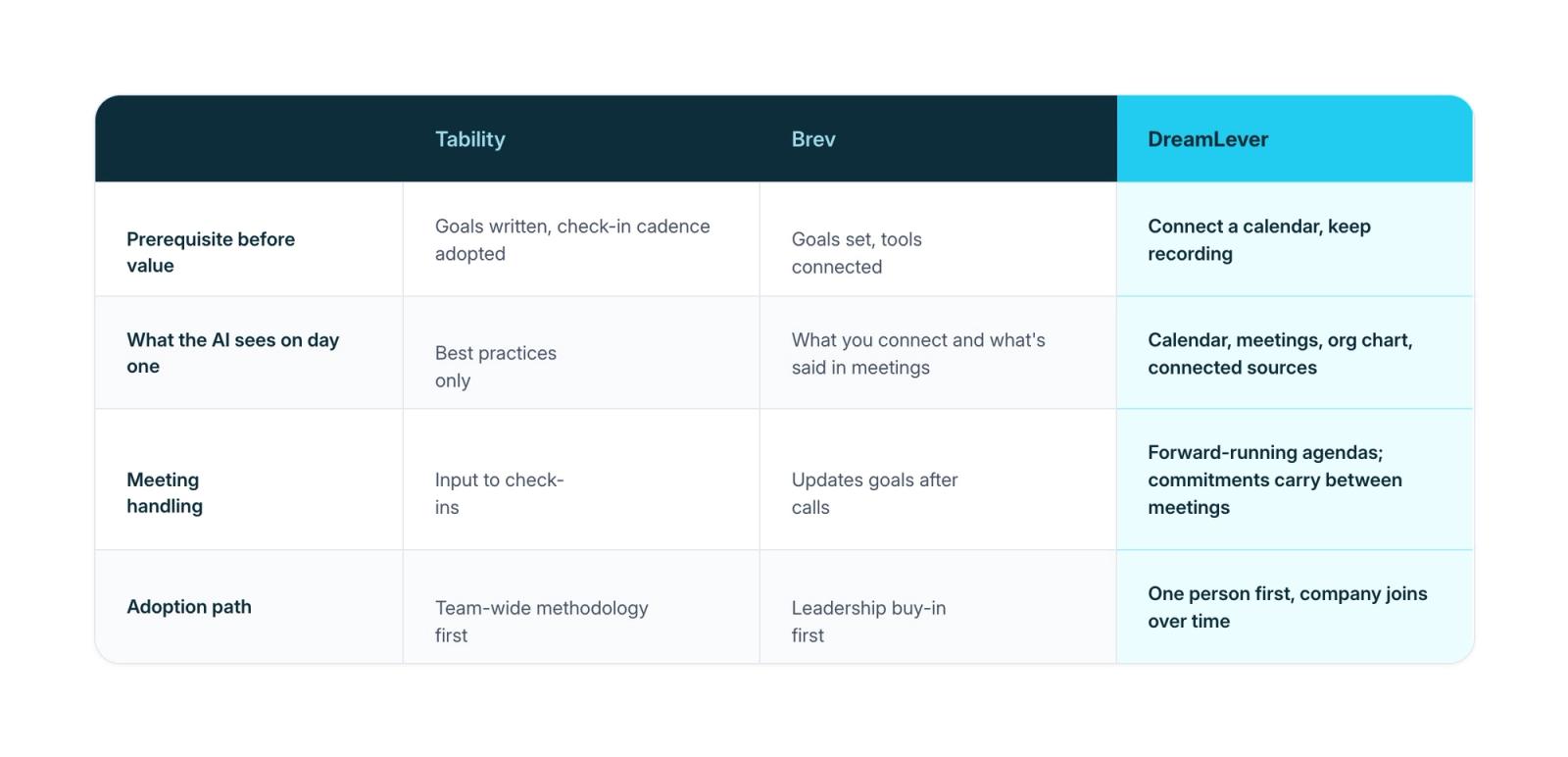
How much each platform’s AI can see about your company on day one
Ranked from most to least, here’s how they compare on this capability:
- DreamLever: A lot, without a single goal added. Our AI works from your calendar, meetings, org chart, connected spreadsheets, and any documents you attach. No goals required. The meeting agendas are central to the platform, and the AI-powered driver of team focus and progress towards pre-established outcomes.
- Brev: A lot, through a goal-centric lens. Its AI recommends OKRs to you based on lines of questioning in the onboarding process. You can connect tools, record meetings, and receive goal insights quickly compared to legacy OKR systems. Real, but revolved around the OKRs, and requiring company-wide buy-in to the methodology in order to get value through the tool.
- Tability: Not much. Its AI is walled off from your data. Day one, it works from best practices until you've populated it with goals and check-ins.
How much organizational change each requires
Lightest lift to heaviest, here’s how the three rank:
- DreamLever: One person connects a calendar and keeps recording. Value comes first from meetings, run through collaborative, AI-powered workspaces. Agents can push information to people across the organization, including teammates who never log in, to solve information siloes, and naturally align team around intended outcomes.
- Brev: Leadership commits to running the company on OKRs. From there, the Slack-native design means contributors spend less time learning a new tool and more time focusing on their goals within the flow of their daily work.
- Tability: The whole team adopts the methodology and the cadence of “updating” their key results with analysis. If the team doesn't sustain it, the value disappears.
How long before you see value
In comparing the platforms, here’s how they stack up from fastest to slowest in delivering value:
- DreamLever: Value starts on day one. Users receive daily briefings that synthesize what happened in their meetings, what matters, and what they need to do to move the business forward. Meetings arrive with agendas already prepped, commitments carry forward automatically, and Miles, the system's AI chief of staff, proactively keeps the team aligned around the outcomes that matter.
- Brev: Early for goal-setting and integrations. Meeting context flows in once you add Brev’s AI recorder to your meetings. Because the whole platform is built around OKRs, written goals and system adoption gate its value.
- Tability: It’s a long path. Value compounds as check-ins accumulate. Goals have to be written, and owners need to be assigned. It’ll take time to see the impact, and it only continues if the team sticks with it.
So, are OKR platforms the right tool for business growth?
If your company already runs on OKRs, someone owns that process, and is ready to drive it from the top down at your organization, then yes, they can be. Otherwise, an OKR-first system is the wrong entry point to institutionalize alignment and outcome-orientation at scale. It's easier to start with a system that learns your operating cadence, reinforces it, and uses AI to drive progress and accountability at scale. Then, when you’re ready, you seamlessly layer in goals. And by that time, they’re drafted from your real work, tied directly to your weekly meetings, and built into the daily briefings and intelligence reports you’ve set up across departments. Goals are critical for organizations, and a goal-centric culture unlocks real gains. AI can multiply those gains, but only with a system that scales across the company and lasts. That starts with something simple enough that everyone actually uses it. See DreamLever live: book a demo.
Free one-month trial
Your first month is free
Book a demo, get set up right away, and run DreamLever for a full month before you decide. No cost, no commitment.
Book a Demo