What Should a Chief of Staff Build to Make AI Work Across the Company?


The AI wave has been skipping the highest-leverage role in any company: chief of staff. As a former CoS himself, our founder, Brandon Katz, dug into this topic during a recent Ask a Chief of Staff event. We’re all well aware that AI has categorically changed what one person can do in an hour, but that output and quickness haven’t yet fully extended to when teams work together. Early in the talk, Brandon explained: “One of the most slept-on impact drivers of AI is just maximizing leverage across the business, and facilitating efficient operations across departments.” From their unique positions, Chiefs of Staff are poised to operationalize this vision.
Why isn’t AI helping teams as much as it helps individuals?
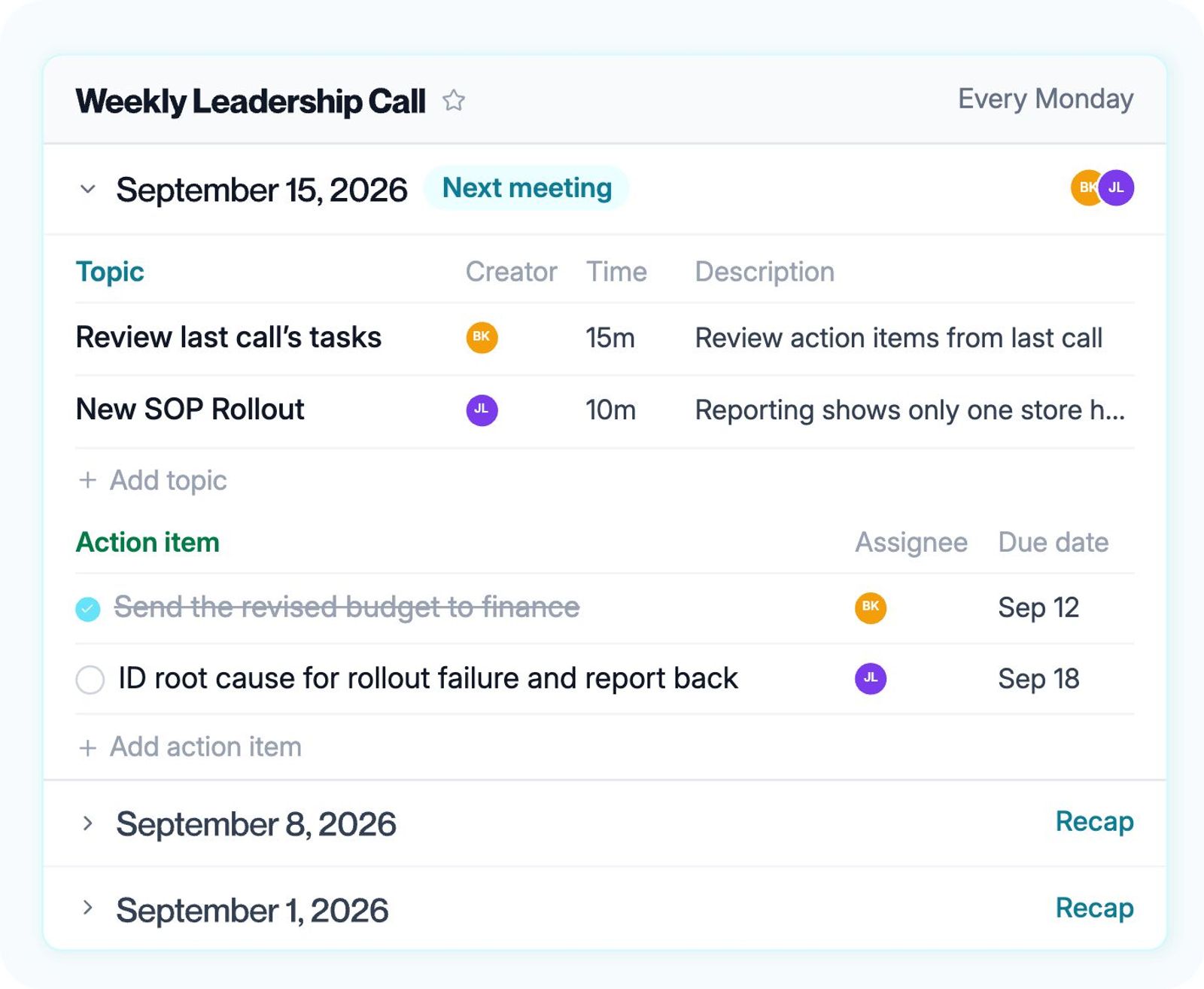
“We all already know AI can help enormously with execution. If you need to draft a document, you go into Claude or ChatGPT,” Brandon noted. But we’re not talking about how individuals execute tasks; we’re focused on how teams work together. He continued: “We're talking about the plague of the Chief of Staff. To ensure that collaboration is efficient, that decisions are getting made, that action is actually assigned between people in meetings, and that managers are following up on it and making sure that people are doing it, and that everyone has the information at their fingertips to understand what work they need to do, what problems they need to solve, and how they need to collaborate with others to get it done.” Those are the most impactful things AI could be doing for companies that are growing rapidly in size, and Chiefs of Staff are the ones positioned to make it happen. Here’s why: they own the operating cadence. From leadership calls to department syncs, those regular meetings are where the real work of moving forward happens. Put those into shared agenda spaces, with topics built in, action items assigned, and transcripts attached, and you’ve created an operational foundation tailor-made for AI to drive your team's progress.
What slows your company down
Consider what impedes speed and agility in your operations. The growth constraints that never surface. The leadership decisions made too slowly. The team commitments that don’t get logged, assigned, and followed up on. These are coordination failures that show up in every business moving from startup to growth mode. Siloes develop, oversight diminishes, and accountability dissolves. Back when everyone was in the same room and in constant contact on Slack, things stayed visible because everyone could see and hear them. “But once you hit a certain precipice of scale, you now have to install communication systems that scale,” Brandon explained.”
How can AI improve cross-team coordination?
When you have a structured record of what your company decided, who owns it, and what happens next, AI has rich, organized context. As Brandon put it: “You can unlock a company brain.”
The hard way to build a knowledge base
Brandon went on to call out what most companies default to when they try to organize context for AI: “You hear a lot about how do you create a knowledge base that AI can leverage to help you succeed, right? And it's like, oh, well, we could organize a bunch of stuff into folders. Ultimately, it just ends up being individual Claude accounts that reference different things.” Why it fails: A company brain only works when the AI is shared, and the agents know who the people are, what they own, and what was said in relevant meetings.
The easy way to build a company brain
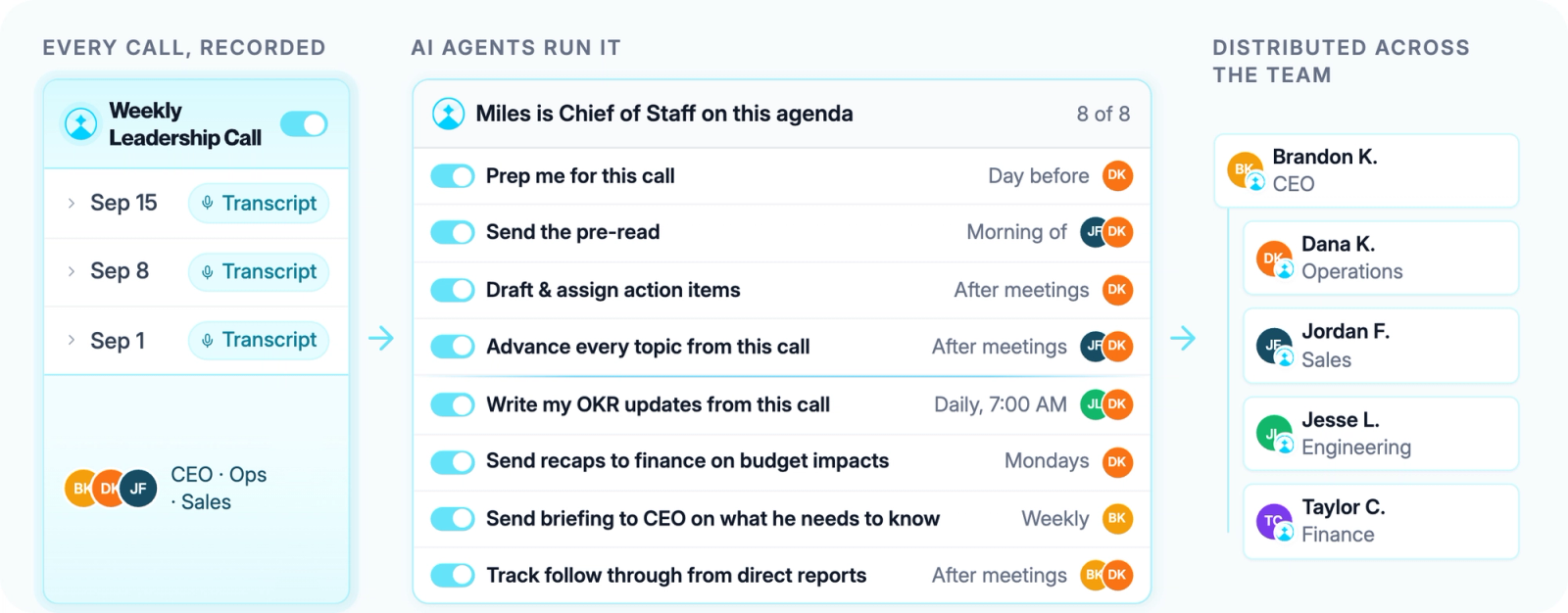
DreamLever is a company-shared AI, built as one system. You connect your calendar and keep recording meetings the way you already do. Every transcript maps to the right meeting, people, goals, and connected sources to build out your knowledge base without you needing to put together a single folder. But DreamLever doesn’t stop there. Because it effectively knows everything about your organization, it also knows how to act on that information. Why that facilitates coordination and follow-through: Agents can chase down overdue commitments, auto-build an agenda from what didn't close last week, surface a problem from the ops meeting that needs to hit finance on Thursday, and give the CEO visibility into meetings they aren’t even in.
What should a chief of staff do about AI?
Forget asking about which tools to adopt. Ask if you’ve built a foundation AI can act on. That's the highest-leverage move for a Chief of Staff right now. Brandon Katz lived inside that seat for years. DreamLever is what he built to solve for its biggest gaps. Ready to see how you can use AI to run management and operations better and more effectively? Book a demo.
Free one-month trial
Your first month is free
Book a demo, get set up right away, and run DreamLever for a full month before you decide. No cost, no commitment.
Book a Demo